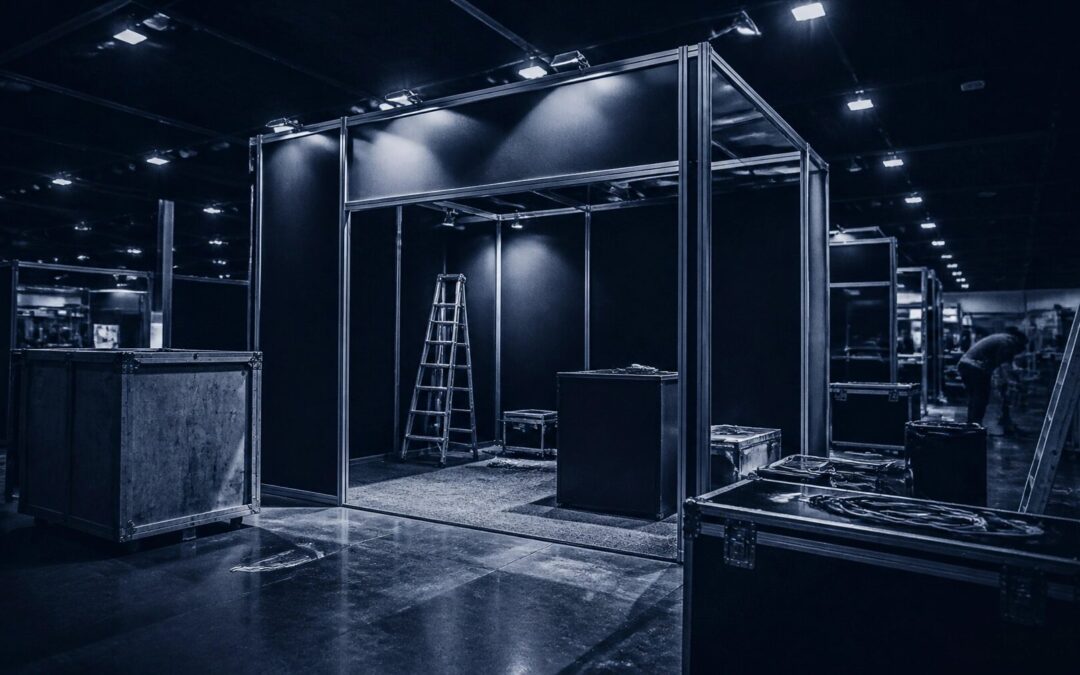
I still remember my first trade show. I was “the guy with the card table.” I had a stack of brochures that weighed more than my luggage, a tablecloth that was three inches too short on every side, and a look of pure panic every time a prospect walked within ten feet of me. I spent four days watching the “big guys” with their $50,000 double-decker booths and holographic displays, feeling like I’d brought a knife to a tank fight.
Since then, I’ve worked hundreds of shows. I’ve learned that you don’t need a massive budget to win; you just need a system. At ShowBulk, we’re obsessed with the “non-vendor” perspective: the idea that you can outsmart the competition without outspending them.
If you’re a small-to-midsize B2B company looking to make a splash without draining your annual marketing budget, here are 25 creative booth ideas I’ve seen work (or used myself) that actually move the needle.
1. The Triple-Threat Banner Wall
Instead of buying a $3,000 custom pop-up wall, buy three high-quality retractable banners. Line them up side-by-side to create a seamless 10-foot backdrop. It’s easier to transport (they fit in a car trunk), and if one product line changes, you only have to replace one banner, not the whole wall.
2. The “Provocative Question” Message Wall
Print a massive question on a foam board that hits a common industry pain point. For example: “What is the one thing your current vendor always gets wrong?” Provide a stack of sticky notes and a few pens. People love sharing their grievances, and it’s the ultimate conversation starter.
3. High-Contrast “Demo Bars”
Forget the standard 6-foot rental table. It creates a physical barrier between you and your prospect. Use a narrow, bar-height table (you can often find these at local event rental shops for a fraction of the show’s “official” vendor price). Set up two tablets on stands for quick, 60-second software or service walkthroughs.

4. The Live “Quick Audit” Station
Create a 5-question scorecard on heavy cardstock. I call this the “7-Minute Health Check.” Invite visitors to sit for a moment while you walk them through a quick assessment of their current process. They leave with a tangible score, and you leave with a highly qualified lead. (I’ll write more about qualifying leads later, but this is a gold mine).
5. Intentional Lighting Upgrades
Most show floors have terrible, flat overhead lighting. Bring your own. A couple of $40 LED clip-on lights aimed at your main graphics can make your booth look 10x more professional. It creates depth and draws the eye exactly where you want it.
6. Tactile Sample Libraries
If you sell a physical product, don’t hide it. I’ve seen great success using modular exhibition units that allow people to touch and feel materials. Using something like modular plywood units gives your booth a “workshop” feel that is far more inviting than a sterile corporate setup.
7. The “Before and After” Storyboard
B2B buyers are skeptical. Use a tri-fold board or a large vinyl banner to show a clear transformation. Use real data: “Company X reduced downtime by 22% in 90 days.” Use charts that look like they came from an engineer’s desk, not a marketing brochure.
8. Branded Die-Cut Sticker Wall
Stickers aren’t just for kids. If you have a cool logo or a witty industry slogan, print die-cut stickers. Create a “sticker wall” where people can peel their favorite. It’s a low-cost way to get your brand on laptops across the industry.
9. The “Selfie Frame” for Social Proof
Create a lightweight, branded frame (think Instagram-style) with a hashtag specific to the event. It sounds cheesy, but if you have a “mascot” or a particularly interesting product, people will take the photo. Every post they make is a free ad for your booth.
10. QR-Code Diagnostic Tools
Instead of handing out 500 brochures that end up in the hotel trash can, print a large QR code on a foam board. Link it to a specific landing page with a “Savings Calculator” or a “Resource Hub.” It’s cheaper, and you can track the analytics.
11. The Mini “Relaxation” Hub
If your booth is 10×10, you might not have room for a lounge. But you can fit a single, high-quality chair and a small side table. Offer a “3-minute phone charge” or a “quiet spot to check email.” It’s a humble way to build rapport.
12. Strategic “Boots-on-the-Ground” Swag
Skip the cheap pens. Offer something useful for the show itself: a high-quality lanyard, a branded water bottle, or even a small tin of breath mints. I once saw a company hand out branded “Exhibitor Survival Kits” (with a band-aid and an ibuprofen): every exhibitor in the hall was talking about them.
13. The Whiteboard Strategy Session
If you’re a consultant or service provider, your “product” is your brain. Set up a large whiteboard and offer 5-minute strategy sketches. Seeing someone draw out a solution in real-time is a powerful way to demonstrate authority.
14. Professional Tablet Loops
If you don’t have a live demo ready, set a tablet on a loop showing a 30-second customer testimonial or a “day in the life” video of your product in action. Motion catches the eye much faster than static text.
15. The Single “Hero” Object
Instead of cluttering your booth with 50 items, pick one. One large gear, one massive printed circuit board, or one oversized model of your software’s UI. Make it the focal point of the entire 100 square feet.

16. Painter’s Tape Mockups
Before you ever set foot on the show floor, use painter’s tape on your office floor to mark out your booth dimensions. Walk through it. Is the table in the way? Can two people talk comfortably? This “pro tip” costs $5 and saves hours of frustration during setup.
17. The “Spin-to-Win” Lead Capture
I know, it’s a classic. But a physical prize wheel still works. Make the prizes B2B-relevant: a free 30-minute consultation, a signed book from your CEO, or a $10 coffee card. The “spin” is the price for a badge scan.
18. Repurposed Industrial Furniture
If you’re in a manufacturing or tech space, don’t use the standard plastic tables. Use wooden crates or metal toolboxes as your display stands. It reinforces your brand’s “workhorse” identity and usually costs nothing if you grab them from your own warehouse.
19. The Micro-Talk Schedule
Print a schedule of 10-minute talks you’ll be giving at the booth (e.g., “The Top 3 Shipping Mistakes to Avoid in 2026”). Display it prominently on a foam board. It gives people a reason to come back at a specific time.
20. Floor Graphics (The Hidden Real Estate)
Most people forget the floor. You can buy removable, “slip-resistant” floor decals quite cheaply. Use them to create “footprints” leading into your booth or to highlight a key statistic right at the visitor’s feet.
21. The “Take One, Leave One” Business Card Board
Create a board where people can pin their business card to “connect with others in the industry.” It creates a sense of community and gives you a peek at who is walking the floor (just don’t be creepy about it).
22. Simple Coffee and Snack Exchange
A small bowl of premium snacks (not the cheap stuff) can be a great draw. Just make sure you have a sign: “Coffee is for Closers (and people who want to talk about [Your Topic]).” It keeps things light but professional.
23. The “Un-Booth” Open Layout
If you can, ditch the front table entirely. Use a clean fabric backdrop and keep the middle of the booth completely empty. It’s an inviting, “low-pressure” setup that encourages people to step inside.
24. Branded Canopy (For Outdoor or High-Ceiling Shows)
If the venue allows it, a branded canopy provides a sense of “place” and makes your booth feel like a permanent shop rather than a temporary stall. It’s a one-time investment that lasts for years.
25. The Post-Show “Instant Follow-Up”
This isn’t a physical booth idea, but it’s the most important one. Have a laptop ready with a pre-written “Great to meet you” email. As soon as a lead leaves your booth, hit send. They’ll get the email before they even leave the hall.

At the end of the day, trade shows are about people, not plastic. My advice? Focus on one or two of these ideas and execute them perfectly. Don’t try to do all 25 at once: you’ll just end up stressed and over-budget.
If you’re just starting out, I highly recommend checking out our First Trade Show Pre-Show Checklist. It’s the same system I wish I’d had when I was that guy with the short tablecloth.
What’s the most creative thing you’ve ever seen at a booth? Or better yet, what’s the biggest mistake you’ve made? I’d love to hear your stories in the comments below. We’re all in this together.
Best,
James Beloff
Recent Comments